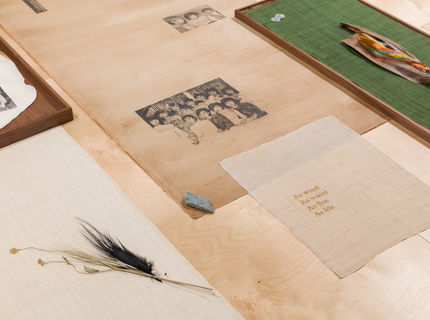
Kang Seung Lee's group exhibition, The dead don't go until we do at Talbot Rice Gallery, Edinburgh, United Kingdom, will be on view March 7–May 30, 2026.
Talbot Rice Gallery's press release follows:
Four exhibitions by: Małgorzata Mirga-Tas / Amol K Patil / Kang Seung Lee / MADEYOULOOK
These four exhibitions are about how we remember those who came before us. The artists use the strength of family, friends and communities to reclaim those who have been lost, erased or excluded. In doing this they provide powerful guides for how we might reconnect with the subtle, everyday realities that make life meaningful.
As the artists show us that remembering is an active process. It calls for silenced voices to be heard again, making it political. But it must also be poetic. It needs languages that can talk about things that are invisible and forgotten. In the face of histories shaped by violence, ownership, profit and pain, remembering demands new forms of understanding.
Artist and activist Małgorzata Mirga-Tas creates large fabric works from the clothes of her Roma family and community. Her work confronts centuries of persecution whilst celebrating everyday moments of joy. She holds close the strength of Roma women past and present.
Amol K Patil draws on the stories of his grandfather, a powada* singer, and his father, a playwright. His installation gives voice to the experiences of people forced by their caste into dark and dangerous spaces. This might be working in sewers, mines or the long walks into the city at night, representing the desire for a better life.
Kang Seung Lee transforms invisibility into a powerful space for memory. Using the language of Korean funeral traditions he often reflects on artists lost to the HIV/Aids epidemic. His new work for Talbot Rice Gallery will pay tribute to Edinburgh’s former queer meeting places and the relationships they once nurtured.
MADEYOULOOK seek a de-colonial relationship to the land. Meaning, the land before European settler rule and private ownership. They map the places once inhabited by the bakoni people in the north of South Africa (circa 1500 to 1820AD). They listen closely to a landscape, ecology and language shaped by their ancient earthworks.
Subtle threads gently weave in and out of these exhibitions. They are not a sombre reflection on death, but a defiant act of remembering. The works are filled with joy, solidarity and care.