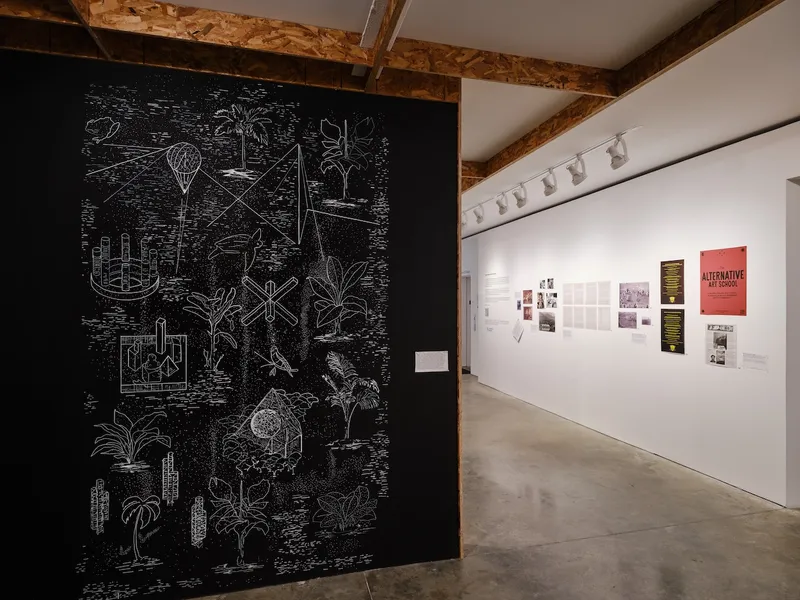
An ever-evolving exhibition, National Academy of Design’s “Future Schools” incorporates an archive, a live performance series, and a curriculum of talks and workshops. Curators Nato Thompson and Natalia Viera Salgado have successfully established a sense of unfolding discovery—and an ongoingness—as they welcome attendees into a warm, lively school-like experience that treats art and design as a vehicle for inspired education. Four new commissions—including a chalkboard drawing by Chloë Bass that references Joseph Beuys’ use of the blackboard—punctuate the dynamic environment.
Created in partnership with Büro Koray Duman Architects, the location—519 West 26th Street, 2nd Floor, New York—has transformed into three interconnected rooms. First, the Reading Room acts as a hybrid archive and study space; it features a large-scale mural of geometric abstraction by Argentinian artist Ad Minoliti, Geometrical speculation can be tender queerness. The aptly titled Classroom presents a “school within a school,” and features A Loudreading Academy by WAl Think Tank, an architectural partnership between Cruz García and Nathalie Frankowsky. Finally, the Symposia offers a place to gather and read, complete with films and zines by Christian Nyampeta (and the ability to produce your own).
Thompson and Viera Salgado set out to survey the potential of alternative art education. As such, “Future Schools” will host classes by LAESCUELA___, the Strother School of Radical Attention (SoRA), and the School for Poetic Computation (SFPC) throughout its run. To learn more, we spoke with the curators following the exhibition opening.
...
Similarly, would you speak to the process behind the chalkboard drawing by Chloë Bass?
NT: We knew early on that we wanted to work with the chalkboard as a medium, and to use it in a way that allowed the process to remain visible. The chalkboard carries a very particular set of associations. It brings to mind teaching, thinking in public, and revision. That felt right for an exhibition centered on education.
We were also looking to a lineage of artists who have used the chalkboard in compelling ways, figures like Beuys and Ligon, where it becomes both an aesthetic and a political space. A place where ideas are not fixed, but worked through.
It felt natural to invite Chloë Bass into that framework. What she proposed, which we immediately loved, was that the drawing would unfold over time rather than arrive as a finished image. The work is structured in four chapters, developing across the duration of the exhibition. The first chapter centers on her practice at the piano. It reflects on what it means to practice, how repetition shapes the body and mind, how it brings you into contact with difficulty, with specificity, with time. There is something very grounded in it, almost quiet, but also quite rigorous.
And then the work continues to evolve from there. We do not fully know how it will unfold, and that uncertainty feels important. It is not a static object. It is a living process, one that mirrors the rhythms of learning itself.
...
Read full interview at surfacemag.com.
