KOOZ The exhibition suggests that space is never empty, but shaped by layered histories of the living and the dead. How do your practices approach space as something already socially and politically inhabited?
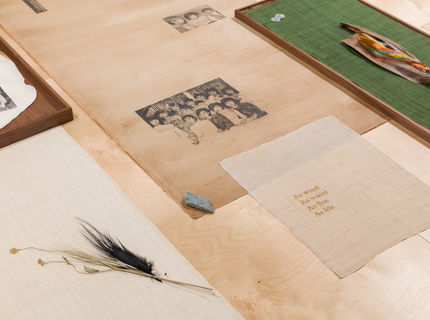
Kang Seung Lee (KSL) For me, space is always already charged — socially, politically, and emotionally — even when it appears neutral or unmarked. I am interested in how certain bodies and histories are made invisible within space, particularly queer lives that have existed in forms that resist official recognition. There are presences that do not announce themselves, that remain just at the edge of perception. My work begins there — by attending to what lingers, what refuses to settle, what quietly insists. In that sense, space becomes a site of both loss and potential reactivation.
Molemo Moiloa & Nare Mokgoth (MYL) Our practice over the past eight years (we have been working together for seventeen) has sought to think beyond the myth and invention of the empty landscape and its attendant violence by claiming intimacy — social and political habitation amongst others — with the land and the more-than-human instead of separation and mastery over these. This intimacy is evident across the multiple layers of Mafolofolo and forms the basis of how we conceive of repair work, and where people from the majority world have had to look for models to rebuild their worlds after cycles of colonial ruination. For us, the models are in everyday black life and the ordinary ways in which people reimagine their relationships to land, both historically and in the contemporary moment. In Mafolofolo we look towards the history of the Koni people, oral accounts and the popular archive of South African resistance songs to witness and learn how relation and sociality with the land and other living beings can help us create ourselves anew.
KOOZ Kang, your work engages archival gaps around the erasure of marginalised communities, while MADEYOULOOK works with landscapes where histories have been overwritten but remain legible. How do you each understand erasure as a spatial condition?
KSL I think of erasure is not as a disappearance, but as something actively produced — through architecture, policy, and social norms. It shapes how space is felt, how bodies are allowed to appear or remain indistinct. Certain lives are not permitted to leave durable marks. They exist instead as traces — partial, fleeting, often misrecognised. I am drawn to that condition, where something is both present and withheld.
My work also tries to remain with that condition — not to “recover” what has been lost in a totalising way, but to dwell in partiality, in fragments, in what cannot be fully restored. The fragment can hold a different kind of density — one that resists closure. Erasure, then, is not an empty void, but a complicated field that shapes how we move through space and how we remember. Also, in queer terms, this resonates with Esteban Muñoz’s notion of ephemera: traces that are not meant to last, yet persist as affective residues.
MYL The project of land dispossession in South Africa has also involved the destruction of ancestral memory and the invisibilising of deeply held relationships between black and indigenous communities and the land. While we cannot account for the sheer magnitude of what has been irreversibly lost, important fragments of these connections remain. Searching for and through these fragments has emerged as an important practice for us and something we think of as an act of repair.
This practice of searching is not entirely about filling in gaps or undoing what has been erased or for that matter about reconstructing some imagined idyllic past, but often involves caring for the fragments themselves, in this current moment. In this way the act of searching is not about the clarity of truth claims, finalisation or even finding, but about connection. Searching has become a labour of honouring both what we know and what has been lost. We search not because artifacts and ruins speak but because the act itself is about forging familiarity with the land through which we search, and in that way is a form of remembering lost connections.
Whatever fragments may emerge from this ritual offer a way for us to think and work through what exists and what remains. But importantly, it also enables us to continue, even with the difficulty of loss.